Fantasy Premier League: Transfers, Captaincy and Chips

The most repeated fantasy football management tip is to copy the template, captain the favourite, and refuse every hit. That tip collapses as soon as your budget, your minutes and your fixtures do not match the template. A transfer, a captain and a chip are separate calls. Each one has a cost, a window and a check against current official data before you lock the team. Prices, points, ownership, form, transfers and expected statistics come from the official Fantasy Premier League data. Read each figure with its season, its gameweek window and the date it was captured. If any of those three is missing, treat the number as unverified and do not play it as live.
A Decision Map for Every Gameweek
Decision | Core question | Test to apply | Evidence to check |
|---|---|---|---|
Buy a player | Does the incoming player improve my starting XI now or over the planning window? | Likely points gain against the current player, role and minutes | Official minutes, role, fixtures and price |
Hold an owned player | Is selling worth the cost or is waiting cheaper? | Expected gain against any hit, budget and rotation risk | Injury flags, expected minutes and squad funds |
Choose a captain | Who gives the best chance of a high return this gameweek? | Secure starter with strong minutes and a favourable fixture | Official next-gameweek xP, minutes and fixture |
Time a chip | Is this the gameweek where a chip adds the most? | Whether the benefit is concentrated in one gameweek or extends beyond it | Fixture structure, squad health and chips remaining |
Wait for team news | Is acting before line-ups worth the risk? | Downside of acting early against the expected gain from the move | Predicted line-ups, confirmed starts and training reports |
The table sorts the decision in front of you. It does not rank players across the league.
The same winger can be a buy for a squad that lacks a starter and a hold for a squad that already owns him.
What each row is asking
Buy a player asks whether the incoming name improves the starting XI now or across the planning window. Test the likely gain against the player you would drop, then check official minutes, role, fixtures and price.
Hold an owned player asks whether selling is cheaper than waiting. Set the expected gain against any hit, the money you would free and the rotation you would accept.
Choose a captain is a single-gameweek call. You want a secure starter, recent minutes and a favourable fixture, read next to official next-gameweek expected points.
Time a chip asks whether this round is where the chip adds the most. See whether the gain sits in one gameweek or stretches past it, then check fixtures, squad health and chips still unused.
Wait for team news is the right row when acting early can cost more than it gains. A predicted line-up or a training snippet is a signal. A confirmed start, completed minutes or a ruled-out player is a fact.
Four limits sit under every row. A transfer has a points cost. Buying is not the same call as holding. A captaincy haul or a chip score does not prove the process was sound. Waiting has value while the evidence is still soft.
Write the call in one line before you open any analysis. Buy, hold, sell, captain or wait, plus the condition that would change it.
The Four-Point Test Behind Every Transfer Hit
Transfers in one gameweek | Points cost | When it is justified |
|---|---|---|
First transfer | 0 points | Any planned upgrade, since the free transfer costs nothing |
Second transfer | Minus 4 points | Expected gain above 4 points over the planning window, or a starting role gain |
Third transfer | Minus 8 points | Immediate starting role gain, a clear availability problem or a multi-gameweek advantage |
Wildcard transfers | 0 points | Rebuild spread across several players that can wait for a Wildcard window |
Under the official Fantasy Premier League rules for the 2026/27 season, each manager receives one free transfer after the first deadline, and every additional transfer in the same gameweek costs 4 points. Unused transfers roll over, up to a maximum of five free transfers, so patience banks flexibility. A hit is a measurable hurdle. It is not an automatic reason to freeze the squad.
Four steps, then one example
Our transfer planning notes follow the same order every week.
Count what is free. After the opening deadline you start with one free transfer. A second move in that gameweek costs 4 points, and a third costs 8, because each extra transfer adds another deduction.
Take the hit off the gain. The incoming player needs to be likely to outscore the current player by more than four points over the planning window, after captaincy, minutes and fixture difficulty.
Judge the window, not one match. A one-week punt needs a stronger case than a move into a confirmed fixture swing. The deduction lands at the start of the next gameweek, so a single appearance has to clear it on its own.
See whether the XI changes. A move that puts a player into the starting side can clear the hurdle. A move that only upgrades the bench almost never does.
Say the midfielder you own will not start. A replacement who is set to start can justify minus 4 if that minutes gap holds for two or three gameweeks. A swap between two benched midfielders cannot. You pay the points and the scoreline stays the same.
A free transfer can rest on a smaller expected gain. A hit should normally need an immediate role improvement, a clear availability problem, or an edge that lasts more than one gameweek. Holding remains rational when the alternative has nicer numbers but the sale creates a new rotation risk or leaves too little money for a later structural move. Wildcard transfers are free, so do not pay hits for a rebuild you can park until a Wildcard window.
Buying a Player Versus Holding One You Own
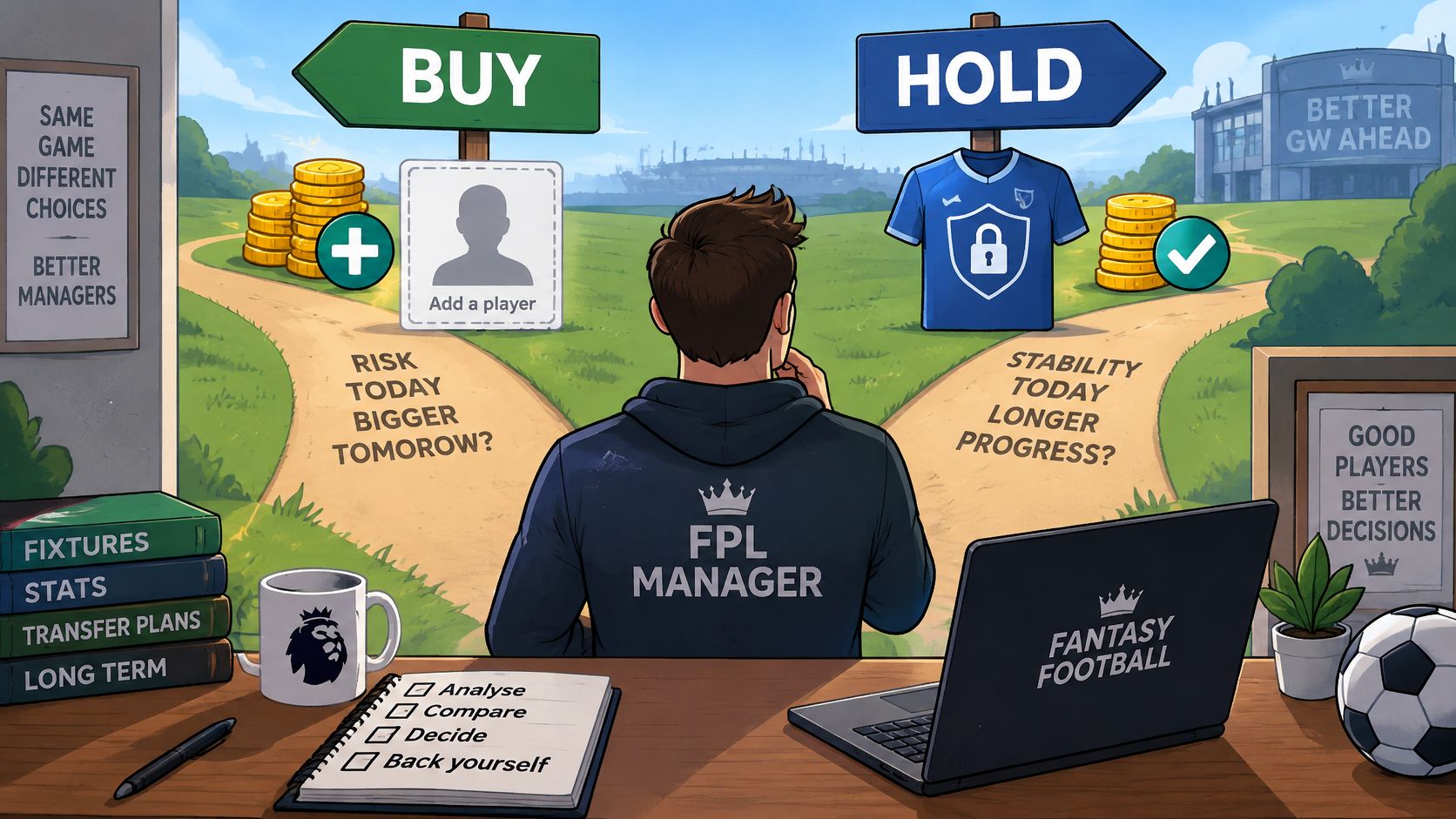
Buying spends budget. The new player has to beat the contribution you already have, once price risk is counted. Holding keeps the funds and skips a deduction, but you keep the risk that the owned player loses minutes or role.
Separate what is known from what is guessed
Confirmed facts are narrow. The player started, finished the minutes, or has been ruled out. Probabilistic signals are wider. Predicted line-ups, training reports, expected goals and ownership shifts can all move without a team sheet.
A Yahoo piece on volatile early-season calls states the minutes bar in the rules. Players need at least 60 regulation-time minutes for the full appearance points and any clean sheet, and stoppage time is excluded. A late cameo and a full shift are different assets for that reason.
Historical expected goals and expected assists show chance involvement. They are not a promise of future returns. A chance-of-playing flag does not guarantee a start.
Practical rule: Hold if the owned player is likely to start. Sell only if the replacement has secure minutes. Delay until team news when the downside of acting early is larger than the expected gain.
An injured defender, two different calls
Say the defender you own is injured and the return date is soft. If a replacement has secure minutes and the fee does not wreck a later move, selling is the cleaner call. If the flag is only a doubt and your defender is still the likely starter, holding is cheaper than guessing the medical update. If both the return and the replacement's role are unclear, wait.
A change of manager can unsettle last season's job faster than a season minutes total implies. Until this season's team sheets repeat the role, treat the old job as a hypothesis. The nine-club managerial figure sometimes attached to the start of 2026/27 is not confirmed here, so it stays out of the call. Price risk sits on the buy. You may pay a rise for a role that has not settled. The hold risks a blank, not a fee you have not spent. I would not turn one training line into a binary buy or sell. I would name the condition and move only when it is met.
Choosing a Captain Without Mistaking Luck for Skill
Build the shortlist from a secure starter, strong recent minutes, a favourable next fixture and a role that creates chances. Official xP is the next-gameweek expected-points value supplied by Fantasy Premier League, used as published. It covers that gameweek alone. Do not read it as a run of future weeks.
Expected goals and expected assists are chance evidence. xGI per 90 is expected goals plus expected assists, scaled to minutes per 90. The figure describes involvement in chances. It does not book the return.
Process on one side, result on the other
Keep a season total away from a recent-form sample. Compare candidates only on the same window. A full-season rate and a five-gameweek rate answer different questions, and mixing them flatters whoever had the hotter slice.
A differential who posts a huge haul can still have been the wrong armband. If the pre-deadline evidence did not support the start, the minutes or the fixture, the result was variance.
Premier League reporting on the 2025/26 season shows how concentrated the winning captaincy was. The 2025/26 champion captained Haaland in 22 of 38 gameweeks and Bruno Fernandes in seven. That is a record of that season's choices and outcomes. It is not a forecast you can copy into a later year.
One correct haul does not prove the risky differential was the better decision before the deadline.
A lower-variance captain usually fits a manager protecting a lead. A differential fits a manager who needs upside and can live with a blank.
Confirm the start from team news, not from reputation.
Check recent minutes so a famous name without a run of games drops down the list.
Compare xGI per 90 for each name on the identical window.
Read the next fixture only, because the official points expectation does not travel further.
Match ownership risk to league position, and take the safer starter when a blank would cost a rank you are defending.
I would rather bank the secure minutes when I am near the top than chase a story that the pre-deadline sheet does not support.
Planning Chips Around Expiry and Fixtures
Chip | What it changes | Best use | Main limit |
|---|---|---|---|
Wildcard | Unlimited free transfers that become permanent | Several players need replacing or fixtures change beyond one gameweek | Permanent, so use it when the rebuild should hold |
Free Hit | Unlimited free transfers for one gameweek only | Temporary fixture imbalance, such as a blank or double gameweek | Squad returns to its previous configuration at the next deadline |
Triple Captain | Captain points tripled | Secure starter with strong minutes and a high-upside fixture | Captain must be chosen before the deadline and only one chip per gameweek |
Bench Boost | Points from all bench players count | Strong bench with players who will play minutes | Cannot be paired with another chip in the same gameweek |
Premier League notes on 2026/27 chips set the stock. Managers receive two sets of four chips, Wildcard, Free Hit, Triple Captain and Bench Boost, which is eight chips in total. The first set has to be used before the Gameweek 19 deadline at 13:30 GMT on Saturday 2 January. Chips left unused in that half do not carry into the second half. Recheck that clock on the official Fantasy Premier League site before a live week, because a moved deadline would change the plan. This remains a draft until that check is done.
Only one chip plays in a gameweek. Bench Boost cannot share a round with Wildcard or Free Hit.
Order the decision by the shape of the gain
Start with the fixture list across the next few gameweeks, not with the chip that feels exciting. Then count how many players need replacing and how healthy the squad is. Pick the chip whose limit matches that shape.
A Free Hit suits a blank or a double that is awkward for one round only, because the old squad returns at the next deadline. A Wildcard suits several broken picks, or a fixture reshape that should still matter next week. The transfers are free and they stick, so you are not stacking deductions for a rebuild. Triple Captain stays reserved for a secure starter with strong minutes and a high-upside fixture. Bench Boost needs bodies who will play, not placeholders.
Say the first Wildcard goes in August because three players merely look uncomfortable. By the time a blank and a double arrive, that first-half chip is gone, and an unused chip would not have rolled anyway. That is the price of spending expiry cover on a mild annoyance. Fixtures, minutes, injuries and budget still need a separate look for whichever chip you keep. I would hold the first-half chip until the imbalance is obvious rather than chase an August ceiling.
Rotation, Bench Cover and the Pre-Deadline Check
Plan two or three gameweeks ahead, then reset after the results. A route map to the final week ignores rotated XIs and fresh injuries. Rotation risk is the chance a player in a sharing side loses minutes. Judge it on the last five or six gameweeks, and keep that sample away from season totals. A player can look safe on season points while the recent sample shows cameos and one early withdrawal. Bench cover is depth where a starter carries a fitness flag, so one flag does not force a rushed move. A three-gameweek fixture run guides minutes and attacking involvement. It is not a points prediction.
Cut the list before you fall for a name
Position, price, minutes and availability filters can remove players who do not fit the squad decision. Differential Picks, Budget Picks and Form Plus Next Fixture are free, and so is every individual player profile. The other 14 maps and nine FPL tools are for paid TFA members. Run the free cut first. A flattering season total should not survive a price tag or a minutes filter it cannot pass.
The habit of lining two players up on one shared window, which StatWarrior's NBA player comparison guide sets out for basketball, is the same habit you want here. Same minutes sample, same fixture length, no mixed seasons. The rotation research view shows who is sharing minutes before a season points column talks you into a trap.
Five checks, then the call
Bound the sample. Put the next three fixtures beside minutes from the last five gameweeks, and keep season totals out of that view.
Mark the sharing pair. Name the teammate who takes the minutes when the starter is rotated, as well as the player you want to buy.
Map the bench replacement. For every flagged starter, name the substitute who plays and the position that stops covering if he does not.
Set the cost of waiting. If the risky starter plays, you keep the transfer; if he is benched or withdrawn early, the replacement and the next fixture decide whether the move was worth it.
Tie the move to a trigger. Write the condition that changes buy, hold, sell or wait, such as two shared starts in the sample or a flag that survives deadline morning.
If the condition is not met, the call stays as written.
Season, target gameweek and capture date still need checking against the official Fantasy Premier League deadline before this reads as current guidance. A conditional call survives a rotated XI. A vague hope does not.