Free Hit FPL Explained: Rules and When to Use It
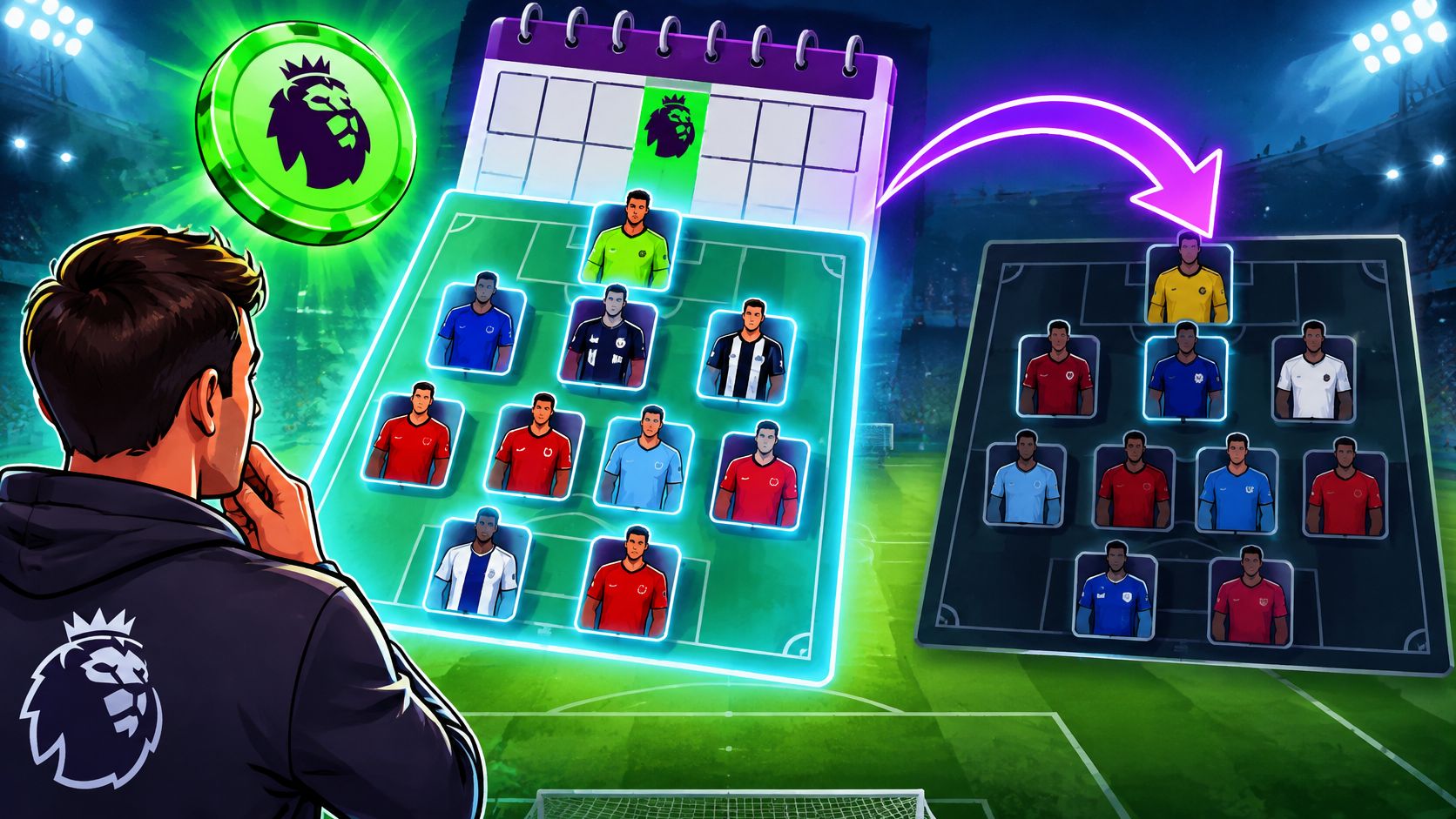
What if the squad you build with a Free Hit FPL chip isn't the squad that decides whether the chip was worth playing?
Most managers judge the temporary XI and stop there.
That misses half the decision, because your original 15 players return at the next deadline with their injuries, blanks and weak fixtures still attached.
My view is conditional. Play the chip when it restores a full, credible XI for one abnormal gameweek and the squad you get back is healthy. Hold it when your normal team already fields 11 likely starters or the players you want need to stay beyond one week.
Treat this as a return-to-squad problem, not a one-week shopping spree.
Free Hit FPL Rules for 2026/27 at a Glance
A Free Hit lets you make unlimited transfers for one gameweek, then your 15-player squad returns to its previous composition at the next deadline.
That single sentence carries the whole strategy, because you're not rebuilding a team and you're not keeping what you build.
Judge the chip on the marginal points it adds in that one gameweek. Squad value, future price rises and how impressive the temporary team looks on paper are secondary.
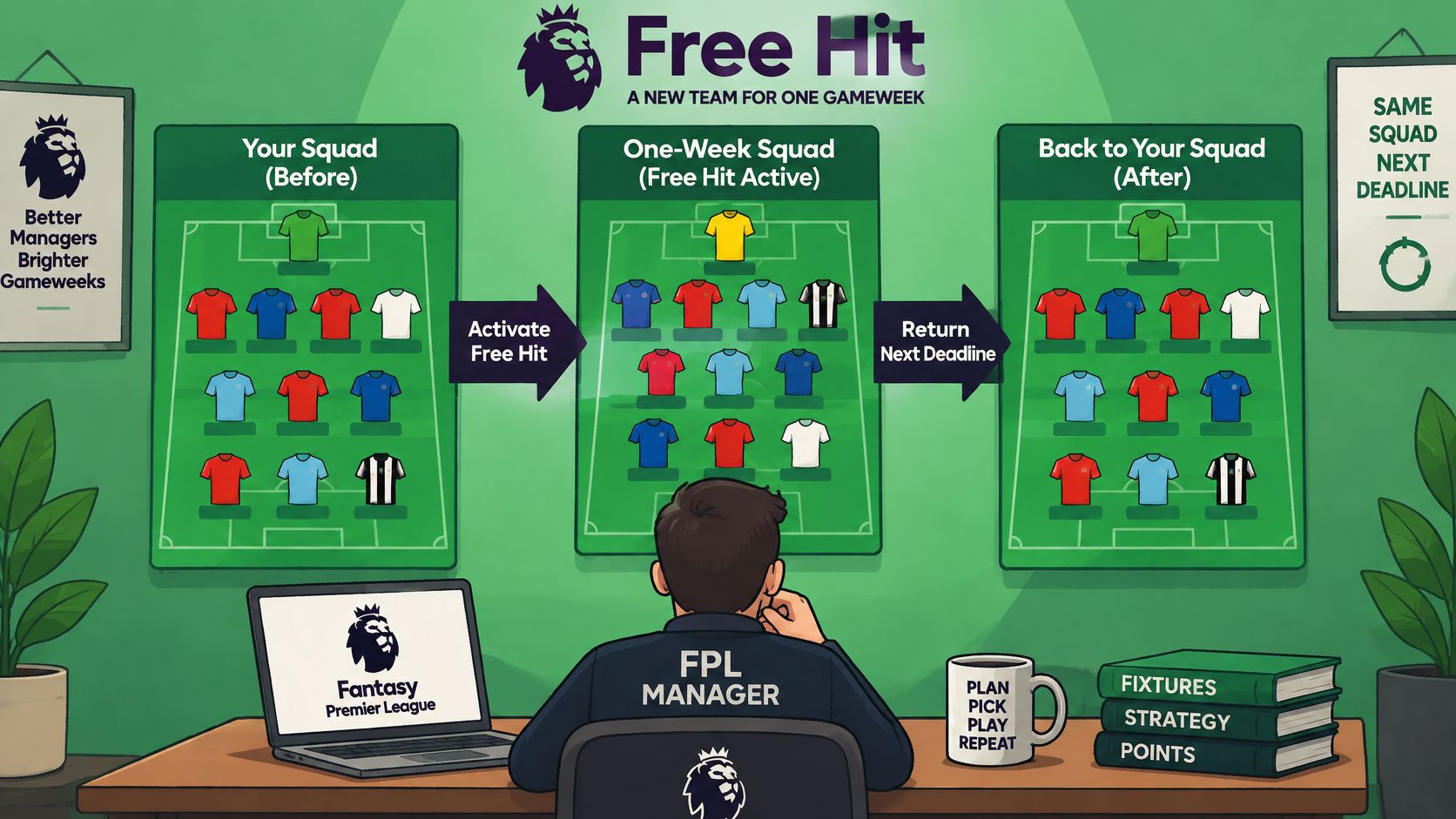
Free Hit Rules for the 2026/27 Season
The official Fantasy Premier League rules describe the Free Hit as a one-gameweek intervention with the squad reverting afterwards, and they set the seasonal windows and limits below.
Rule | 2026/27 position | Effect on the squad |
|---|---|---|
Gameweek 1 | Not allowed | The first chip can't be used before Gameweek 2 |
First chip window | Available after Gameweek 1, must be played before the Gameweek 19 deadline | Plan the first chip inside this window |
Second chip | Available from Gameweek 20 | Chip timing is a season-long choice |
Chips per gameweek | One chip only | Free Hit planning must align with Bench Boost, Triple Captain and Wildcard |
Consecutive gameweeks | Not allowed | A Free Hit used now can't be repeated in the next gameweek |
Cancellation | Not allowed once confirmed | Check the target gameweek and squad before confirming |
Banked transfers | Retained when the chip is played | Saved free transfers carry into the next gameweek |
Squad after the gameweek | Original squad returns at the next deadline | Price gains on temporary players aren't kept |
Why the One-Week Limit Changes the Maths
A normal transfer usually needs several gameweeks to repay its cost, so a quiet first week doesn't settle the argument.
A Free Hit player gets one match. Rotation, an early substitution or a late team-news surprise can't be recovered later.
That's why the chip fits a squad with several players facing zero expected appearance through a blank, a postponement or concentrated availability risk.
It converts budget tied up in players who won't feature into active starters, while leaving your established structure untouched for the following weeks.
It fits badly when your problem is permanent, because the same injured or out-of-favour players come straight back.
Score the chip on the points it adds in the target gameweek after captaincy and transfer costs avoided, not on the raw total your temporary squad projects.
No single target gameweek is fixed yet for 2026/27, so confirm the exact chip windows and deadline on the official rules before you act. Those windows shape every choice that follows.
If a rule can't be verified there, treat it as a gap rather than a fact.
Free Hit Versus Wildcard and Ordinary Transfers
Feature | Free Hit | Wildcard | Ordinary transfers |
|---|---|---|---|
Duration | One gameweek | Permanent | Permanent |
Transfer limits | Unlimited for that gameweek | Unlimited | Free transfers, then points hits per extra move |
Squad after the chip | Returns to previous squad at next deadline | Stays as built | Stays as built |
Price gains on new players | Not kept | Kept | Kept |
Banked transfers | Retained | Not yet confirmed | Spent as used |
Cancellable once confirmed | No | Not yet confirmed | Not applicable |
*Wildcard banking and cancellation rules are not yet confirmed for 2026/27, so treat both cells as open questions rather than assumptions.
A Short-Term Let Versus a Purchase
A Free Hit works like a short-term let. A Wildcard is a purchase.
You occupy the Free Hit squad for one round of fixtures, hand it back, and keep none of its value. The Wildcard squad is yours afterwards, so every price rise, injury risk and bad fixture run you build into it stays your problem.
That distinction decides which tool fits, and it should be settled before you look at individual players.
Say your squad has four players with no fixture this week but an excellent run afterwards. That is a let. Say half your squad has lost its starting place. That is a purchase, and a Free Hit only delays the repair by seven days.
The comparison also runs across two deadlines, not one. Score the temporary XI for the target gameweek, then score the squad you get back at the next deadline. A Wildcard and an ordinary transfer each score once, because there is no return leg to weigh.
Where Ordinary Transfers Sit
Ordinary transfers suit one or two targeted changes, where the incoming player improves your XI now and holds his place afterwards.
Each move beyond your free transfers carries a points deduction, so extra moves must earn back their deduction before they add anything. A Free Hit removes that arithmetic for one deadline only. That matters most when the problem is wide but brief: four forced changes for a single week would stack up several deductions, while the chip costs nothing at that deadline.
When the incoming player is a genuine hold, the equation flips. An ordinary transfer then earns across many gameweeks, which a temporary squad never can. Our FPL transfer tips guide covers the week-to-week judgement behind those ordinary moves in more detail.
Practical rule: if you expect to keep the new players beyond one gameweek, the Free Hit is the wrong tool.
Choose the Free Hit for a fixture or availability problem confined to one gameweek. Choose the Wildcard when the squad needs rebuilding beyond one week. Choose ordinary transfers when the fix is narrow and the player coming in is a genuine hold.
How to Build a Free Hit Squad Around One Gameweek
Start with one question: How many players in your current squad will start in the target gameweek without the chip?
If that number is already 11 with a workable captain, the temporary squad has to beat a functioning team rather than a broken one.
The Premier League guidance on returning to your previous squad states that managers can't benefit from price changes generated by Free Hit selections, while price movements affecting the original squad still apply when it returns.
Build from that constraint, not from a blank team screen.
Six Steps for the Temporary Squad
Count viable starters in your current squad for the target gameweek, position by position, before you draft anyone new.
Check confirmed status, including each player's injury flag, suspension and expected minutes, and treat doubtful players as bench cover at best.
Prioritise secure minutes, then add set-piece and penalty duties, attacking involvement and clean-sheet probability, since there's no holding period to recover from rotation.
Remove price-rise picks, because a player bought only for a future rise gives you nothing when the temporary squad disappears.
Judge the returned squad for the following gameweek alongside the temporary XI, including its bank, injuries and first planned transfer.
Choose the captain from the temporary team, using official xP for that next gameweek only and never as a multi-gameweek forecast.
What Each Metric Actually Supports
Season expected goals and expected assists show a player's chance involvement over a longer sample, which helps separate a repeatable role from a lucky finishing run.
Derived xGI per 90 adds a minutes adjustment, so it compares players with different playing time more fairly.
A recent-form sample shows current role, whether a player has moved position, won set pieces or started sharing minutes.
Keep those windows separate, because mixing season totals with a short recent run produces a number that describes neither.
None of them is an FPL points forecast, and a strong xGI figure doesn't promise a return in one specific match.
Official xP is narrower still. It's a next-gameweek value, so it can inform a captaincy call this week and says nothing about the three weeks after.
A chance-of-playing flag doesn't guarantee a start either, so a flagged premium with uncertain minutes can be a worse Free Hit pick than a cheaper nailed starter.
Spend the budget on certainty first, then on ceiling, because a zero from a rotated star can't be averaged out later.
Bench order still matters for one week, since a late withdrawal turns your first substitute into a scoring player.
End with the only test that matters. Calculate the incremental expected score of the temporary squad after captaincy, bench points and transfer costs avoided, and compare it with what you'd field anyway.
Judging Whether a Free Hit Beats the Alternatives
Play the chip only when its incremental expected score clears the cost of every realistic alternative.
That condition holds whether the gameweek looks awkward and whether rival managers are playing theirs. Both facts feed the calculation, and neither settles it.
The Premier League guide to 2026/27 chips specifies two Free Hit chips across the season, with the first available after Gameweek 1 and required before the Gameweek 19 deadline, and the second available from Gameweek 20. Scarcity is the baseline every comparison works against. A transfer can be repeated, so a Free Hit has to clear a higher bar than the move it replaces.
Five Tests Before You Commit
Compare both XIs for the same gameweek, setting the temporary team's expected score against your unchanged squad's, including your best available captain in each.
Price the ordinary route, working out how many points hits you'd need for a legal, competitive XI and whether those transfers stay useful afterwards.
Check the rival chips, because only one chip can be played per gameweek, so a Bench Boost, Triple Captain or Wildcard planned for the same round has to move.
Score the squad you get back, since the chip returns your original players at the next deadline. A temporary XI that wins the week but hands you straight back to a squad facing a poor fixture run may still lose the trade overall.
Weigh what you avoid, including permanent transfers you'd rather not make and future fixture swings that favour the squad you already own.
The Strongest and Weakest Cases
The strongest case adds several clear starters, carries genuine captaincy upside and restores a squad that still looks strong for the following week.
The weakest case buys players whose value depends on staying in the team, which the chip can't deliver.
Between those poles sits the common trap, a draft that upgrades two or three places and swaps one good captain for another. That kind of gain rarely justifies spending one of two season-long plays.
Distinguish buying from holding here too. A player you already own with a poor fixture may still be worth starting, because replacing him for one week costs a chip rather than a transfer.
Our fantasy team analyzer guide walks through comparing your current squad against alternatives before you commit to changes.
Fitness and availability checks belong to squad building, so this decision turns purely on which option wins the comparison. Any rule detail you can't confirm for the current season counts as an open question in that comparison, not as a point in the chip's favour.
A narrow projected edge is a reason to keep the chip, not to spend it.
Peak Free Hit Gameweeks and What They Reveal
Free Hit demand concentrates in a small set of gameweeks rather than spreading evenly across a season. The size of each peak measures how much pressure that week put on an ordinary squad.
Largest Published Free Hit Gameweeks
Season and gameweek | Free Hit plays |
|---|---|
2023/24 Gameweek 29 | 1,705,262 |
2020/21 Gameweek 18 | 1,410,195 |
2025/26 Gameweek 31 | 1,344,160 |
2024/25 Gameweek 29 | 1,189,224 |
2022/23 Gameweek 12 | 1,063,311 |
All five totals come from the Premier League's published Free Hit figures, and the largest exceeds the 2020/21 Gameweek 18 mark by 295,067 plays, or 20.9%. Every listed peak clears one million plays.
Treat each figure as an aggregate chip count for a completed gameweek. It measures demand in that week, and on its own it cannot show how many individual managers were behind the total.
What the Pattern Can and Can't Tell You
Heavy use tends to coincide with postponements, blank gameweeks, double gameweeks and tightly concentrated schedules, because those weeks make a normal squad less efficient. That remains an analyst judgement. The count alone does not prove why managers acted, so treat any specific gameweek's cause as unconfirmed until that week's fixture calendar supports it.
A peak is also two decisions taken at once. Every manager in those totals bought a temporary XI and simultaneously chose the squad they wanted back at the following deadline. The size of a peak therefore measures how many managers rated their restored squad as worth protecting, as much as it measures demand for new players.
There is a strategic consequence. When large numbers of managers play the chip in the same week, the obvious fixture-driven targets become widely owned for that round, and the edge from picking them narrows. Your gain then depends more on captaincy and on the two or three places where your draft differs.
Compare the calendar around your target week using our FPL fixtures research before deciding. Keep completed-gameweek usage figures separate from live data, which runs on different cycles: live gameweek points refresh every minute, and member market data refreshes every 15 minutes.
A historical peak tells you where pressure has built before. Whether your squad faces the same pressure is a separate judgement, one made from your own fixtures and from the squad waiting for you at the next deadline.
Common Free Hit Mistakes and the Pre-Confirmation Check
The most expensive error is treating the Free Hit as a permanent upgrade.
Managers buy a player for a fixture run, a captaincy option or a role they want to keep, then watch him leave at the next deadline with none of that value retained.
Everything else on this list costs less, but each one is avoidable.
Mistakes and Their Fixes
Playing it in Gameweek 1: it isn't allowed, so check the window before you plan a draft around the opening fixtures.
Confirming without recording your squad: confirmation can't be cancelled, so note your pre-chip 15, bank and injury status first.
Using it for one blank: if you still field enough starters, you're spending a chip your restored squad may need more later.
Spending banked transfers early: the chip keeps them, so burning saved moves beforehand throws away flexibility for nothing.
Reading xP as a forecast: official xP covers the next gameweek only, so don't use it to justify a three-week plan.
Trusting a playing flag: a chance-of-playing percentage isn't a confirmed start, so price in the rotation risk.
Ignoring the adjacent gameweek: you can't repeat the chip immediately, so a second disrupted round needs its own plan.
The Pre-Confirmation Checklist
Confirm the chip window and target deadline on the official rules, on the day you plan to act.
Record the pre-chip position, covering your squad, bank, injury status and the next permanent transfer you intend to make.
Check chip clashes, making sure no other chip is set for the same gameweek and none is planned for the gameweek either side.
Set captain and bench order for the temporary team, because both still score points in a one-week squad.
Verify every player against official data on the day, including club, price, availability and expected minutes.
Two product notes matter when you do that checking with us. Differential Picks, Budget Picks and Form Plus Next Fixture are free, along with every individual player profile, while the other 14 maps and nine FPL tools are available to paid TFA members.
TFA projections are estimates, not official FPL forecasts, so use them to rank options rather than to promise a return.
Before you confirm, ask whether you'd still play the chip if your captain blanked. If the case collapses, it was never strong enough.
Judge the chip on both halves of the trade: the XI you field for one week and the 15 you get back at the next deadline.
Play the Free Hit if the one-week gain is clear, the minutes are secure and the returned squad is sound.
Buy specific players through ordinary transfers only when their role, minutes and fixtures justify keeping them after this gameweek ends.
If the squad you'd get back worries you more than the gameweek you're targeting, keep the chip and fix the actual squad gap with transfers instead.